
SYSTEMS CHANGE IN PRACTICE II: The challenges for grassroots organisations and some considerations for funders
Authors: Ida Dangi and Natasha Ereira-Guyer. In conversation with our panellists (Tom Bell, Kerry Edwards, and Lucie Brooke) and those that joined our online discussion.

This is the second blog in our Systems Change in Practice series. Our first blog outlines what systems change is, and the three key takeaways from our online discussion with Tom Bell, Kerry Edwards, and Lucie Brooke, and over 70 people from the VCSE and beyond. We explored what funders are looking for when they ask for systems change, and clarified that grassroots organisations have particular superpowers because of their knowledge and insights. In part II, we want to focus on the very real barriers grassroots organisations face to doing more systems change. The intention is to provide (1) some food for thought for funders that are asking for systems change, and (2) some validating encouragement for grassroots organisations - especially those we’re working with through Nurturing Grassroots. In part III, we end on a positive note, by sharing some tips on how organisations can navigate systems change. A podcast of the online discussion from which these blogs are drawn from, can be found below.
Systems change is all about working together to tackle the shared root causes of societal issues - the underlying systems that govern our lives (refer to Part I to understand why this is). It can be difficult for grassroots organisations to do this: it’s difficult to nudge and enable the system, which has the might of the status quo behind it, to change, especially when you have limited resources, increasing demand and urgency for your work, and an unstable funding landscape. For most grassroots organisations, their focus is (and has to be) on supporting their communities. It is difficult for sparsely resourced organisations to switch their priorities to systems change. Many are balancing direct delivery along with navigating the systems in which they are placed. If funders give priority to organisations that are fully able to tackle systems change, then we might leave behind the ones that are doing work that is equally important to the community.
Here are the five main challenges grassroots organisations face to doing more systems change work:
1. Systems change sounds complicated, abstract and out of reach
Grassroots organisations are highly aware of the wider systems that they are operating in. They have to exist within the system everyday in order to exist, and to provide the services that their communities need. No one disagrees that systems change is needed. However, grassroots organisations at our event confirmed that the literature around systems change was overwhelming “what the heck is systems change, indeed!” they joked. Many simply do not have time to make sense of this abstract concept - especially those who, because of the sudden change in funding priorities towards systems change, are unable to access the funding they previously had.
In addition, systems change can look different in different contexts, and each organisation has limitations on how much they can challenge the system. They each need capacity and support to understand how they can meaningfully contribute to systems change in the most effective way - including how they can build systems change practices into their work without it detracting from their capacity for direct delivery. They also need the assurance from their funders that their systems change endeavors will be valued, even if it does not lead to tangible outcomes that can be measured and recorded (read our blog about systems change evaluation to understand why capturing systems change impact can be so challenging)
2. With ever increasing demand and urgency for support, there is a profound lack of capacity for pushing against a broken system
As always, limited capacity presents a huge hurdle for grassroots organisations to take on additional work, such as contributing to meaningful systems change. Many small but mighty micro organisations are operating on an annual income of 10k or less. Sakib, a member of the LGBT+ Consortium, notes how even the smallest amount of money that is allotted needs a large amount of paperwork. At our event, he offered perspective as a funder and highlighted that there needs to be increased trust within a granter and grantee relationship, where grassroots organisations are given a bit more space and time to develop the programs that they need (something that LGBT+ Consortium is trying to achieve in their funding relationships). Grassroots organisations are not just navigating the systems that are directly relevant to their social cause, rather, they also need to navigate the funding system and the various layers of management and collaboration that that entails. Tom clarified that while similar funders might be moving away from day-to-day delivery and focusing on systems change work, Henry Smith Foundation is committed to balance both.
“Systems change is a kind of clearer, more deliberate focus for us. But the majority of funding that we expect to deliver will still focus on supporting direct delivery. And those organisations, they're the foundations of any fair system and without them there's nothing to build on.”- Tom Bell
3. Pushing against a broken system comes at a personal cost to leaders of grassroots organisations, and can feel risky, daunting and tiring to them
Everyone in the charity sector is at high risk of burnout. For some, it is not their only job. For others, they use their own lived experience to deliver good work and are fuelled by a lot of love and care for their community. Some highlight that the collaboration needed for systems change can lead them to jump from one consortium meeting to another with little space for their own organisational planning. This also leaves less time for innovation, and creativity within the services that organisations can provide.
“[The sudden expectations to do systems change] are just undermining the voluntary sector's crucial role of responding creatively to injustice in society” - Neima Macfoy
What’s more, individuals driving systems change put themselves in the firing line and therefore further risk of burnout. People fear being labelled as trouble-makers, use up a lot of emotion, and have to dig up their own lived experiences/trauma. “We have to really make sure that [in asking people with lived experience to do systems change] we're not creating conditions for further harm” says Tom. For example, advocating to a funder that they could improve their funding practices feels scary if you are hoping you might get a grant from them one day. In other words, telling the system things it doesn’t want to hear comes at a personal cost to those leading the change. This raises questions as to whether there are enough safeguards for organisations that are undertaking this sort of work.
Tom agreed on this. He noted that, while Henry Smith Foundation cannot escape from the power dynamic that is inherent in any funding relationship, they can - and they have - taken conscious steps to reduce the power dynamics by acknowledging that they can’t have any impact without the organisation being there”. Systems change is a two way street, and the system itself needs to be in constant dialogue with those trying to change it.
“We want to bring grassroots organisations in and get them to change systems and we're exposing them to all the good, bad and ugly that exists in the system” - Dierdre Cole, Hackney Council
4. How do you get your voice heard, anyway? Is the system primed for change?
For systems change to happen, the system needs to be open to change. More specifically, those within the system need to be ready to listen and do their bit to create opportunities for new attitudes, norms, beliefs, relationships, policies and procedures. Sometimes systems change involves participatory exercises with the system.
“Sometimes the requirement for system leadership also requires a certain amount of humility to listen.” - Mark Hayward
Sakib, noted that it’s their job as a funder to create spaces that are inclusive and accounts for individual structural barriers, so that everyone can participate/contribute:
“A lot of people who run organisations have a day job, maybe another job, and then they run their organisation. So you setting your consultation at midday isn't going to work because they can't do it.”For Sakib, there is a question that needs to be constantly asked and reckoned with. “we're always thinking, who hasn't turned up, who haven't we heard from, who isn't in that space?” .
Lucie, one of our panellists, is the Co-founder and Director of Free2B, a community organisation in London supporting LGBTQ+ young people. She brought the example of LGBTQ+ young people who are not always able to attend certain large consultation events, because of either lack of gender neutral toilets, concerns around financing, public transport, mobility, time of day, and so on. While systems change focuses on collaboration and bringing everyone together for a shared purpose, sometimes grassroots organisations could get left out due to significant structural barriers. Tom agreed: “Funders, organisations, and individuals need to constantly reconcile these barriers in an attempt to create equitable spaces.”
All this said, it is not just grassroots organisations that are lacking capacity, the statutory system also has incredibly limited capacities, which makes systems change difficult even if many people within the system want to change. Lucie explained that the biggest challenge preventing her organisation from driving more systems change within the education system was the capacity of people working in the schools. For example, a one hour ‘Have PRIDE in your School’ training is about the longest they can get schools to commit to - and it is often difficult to get schools to sign up for multiple trainings especially if there is a cost involved.
5. Building trusting partnerships in a competitive environment
Systems change is all about building solidarity - moving away from treating symptoms in our silos and moving towards working together to address shared root causes. This is not easy to do when you’re competing for funding with the very people you need to partner with. Look out for more discussion on this in Blog 3, where we speak about the importance of collaboration and solidarity.
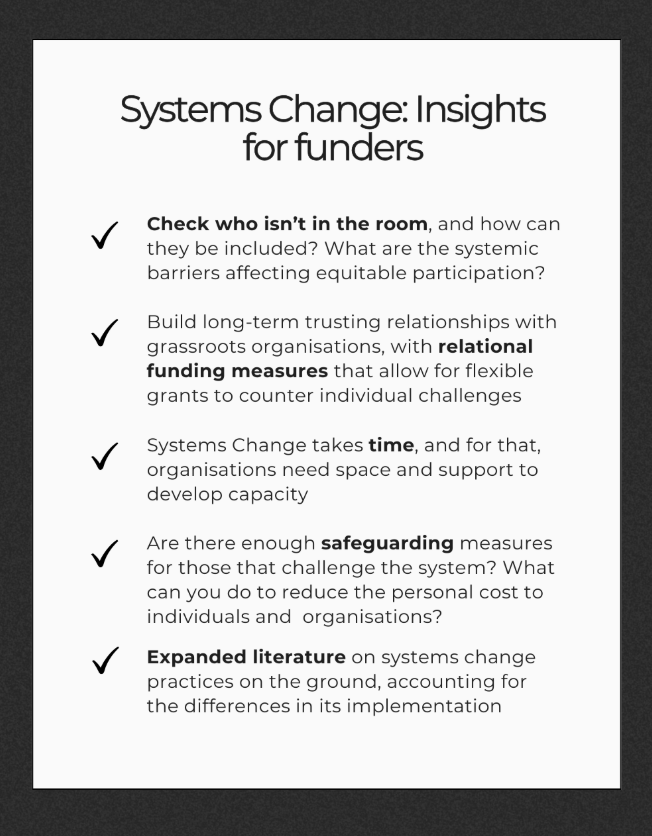
6. Some considerations for funders
So far, we have discussed the challenges that organisations face while navigating systems change. On the flip side, our discussion also shed some light on possible different ways in which funders too are adapting to these challenges and can support organisations as they navigate systems change. Here are some insights gained from our discussion above.
In this blog, we have given ourselves permission to be skeptical and negative about the challenges that grassroots organisations face while navigating systems change. Refer to Blog 3 for the positive take-aways - five tips that came out in our discussion.
